
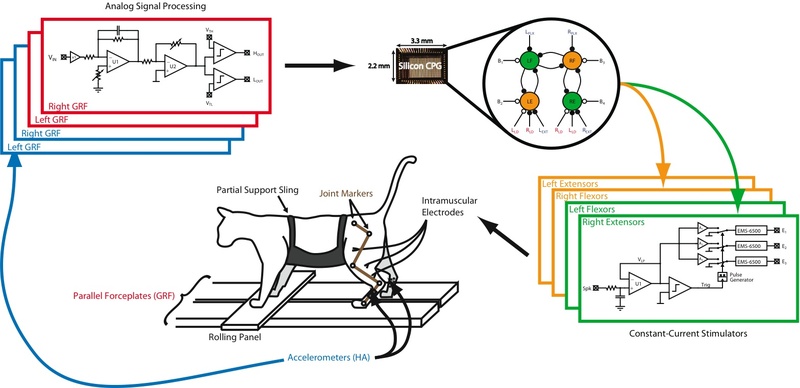
 While I was at Johns Hopkins University during the summer, I found out about the first demonstration of a new chip that can be used to stimulate locomotion in an animal (tested on a temporarily-paralyzed cat, see right). Unlike previous controllers, this one is tiny and low-power. However, it can still take account of the sensory input coming from the movement of the limbs through a tiny neural network.
I find the work very interesting and, potentially, extremely important. Rather than explain it here, I recommend you check out the story I wrote for EE Times on the subject. Let me know what you think.
Diagram: The schematic of the experiment showing locomotion stimulated by a central pattern generator (CPG) chip.
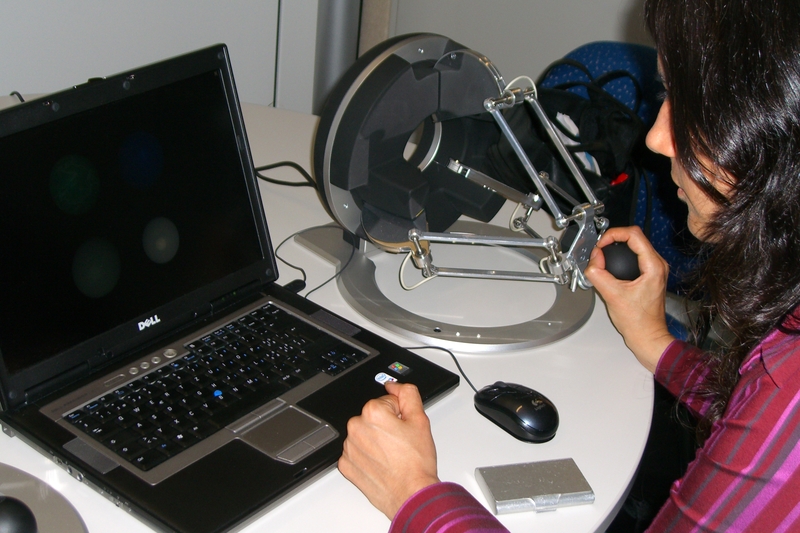
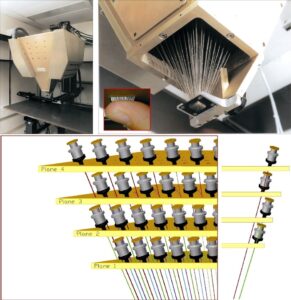 I’m interested in different ways of displaying information to our bodies, and particularly to our skin. So, in my June visits to the Washington DC area and to Switzerland (Zurich and Lausanne), I made a point of trying to see as many people working with tactile and haptic displays as possible. I had the opportunity to try three very different devices, which made me realize just how difficult a problem this is.
  When I first heard the story about the
  One of my colleagues told me at lunch that he’d seen an
  After the last couple of posts I got some interesting comments about familiarity being important to intuition. Roger Attrill pointed out that Adobe users would find Photoshop intuitive (while others wouldn’t) and Bob Salmon pointed out that musicians might find software using some kind of musical-score based interface natural to use that the rest of us wouldn’t.
  During my recent research into the world of sensory interfaces, I had at least a dozen discussions, maybe more, about what the word intuitive means. I can’t remotely claim to have cracked this: on the contrary, it seems to me that people are still at the stage of figuring out the right questions to ask. It’s true that human-machine interfaces have been well studied and there’s vast literature on the subject. However, though sensory interfaces that allow you to interact with the real world (rather than a computer world) will certainly have many things in common with virtual displays, I think there will be some differences too.
  One of the aspirations of those trying to feed information into the brain through the senses is how to make the process intuitive. Roughly we know what this means: we want to have the information be self-explanatory, to not require any further thought, to immediately and naturally provoke the behavior that we intended. But what exactly does this mean in practice? How does it break down?
  Biological brains can do something that we’re still working on building into machines: rewire themselves to take advantage of the best information available. This is a well-known phenomenon, but it’s not widely understood just how radically different the rewiring or optimized wiring can be from what is considered ‘normal’.
  Stefan Marti is a research scientist with Samsung in San Jose. When he was a student, he had the experience of walking around with a broken vibrating pager that gave him an unexpected extra sense: for certain kinds of electromagnetic fields. From the buzzing in his pocket, he knew when people were making popcorn in the microwave, when there was a wireless router nearby and, most interestingly, when a phone—whether his or someone else’s—was about to ring.