
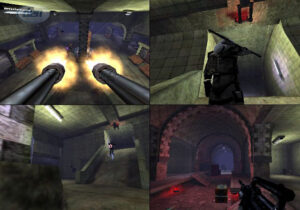
 In my previous posts I discussed using tactile displays (the tongue display and spatial-orientation vest) in order to sense the world in new ways. In both cases my immediate reaction was to close my eyes, which may seem foolish: I was cutting out visual information that might have been useful. However, there was method in my madness. Read More …
Category: Interfaces
A new kind of military conflict
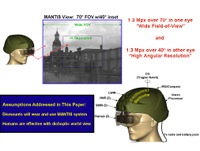 We are notoriously bad at simultaneously doing different tasks with the same bit of brain. For instance, in his book Seeing Voices, Oliver Sacks points out that it’s known to be extremely difficult to sign in American Sign Language while speaking in English, which has a completely different syntax and grammar. Likewise, it is thought to be impossible for someone to write Chinese while speaking English. So, if the tongue and the skin are providing imagery to the brain (as discussed in the last post), it may be important that it’s complimentary to that coming from the eyes: enriching the visual stream rather than feeding in some completely new kind of information. Read More …
A little night vision
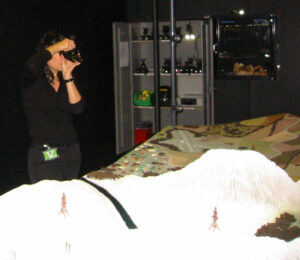 Over the last couple of weeks I’ve had the chance to try two pairs of night vision goggles (NVGs). The first I tried while on a visit to the Royal Air Force base at Henlow (see right). I was allowed to sit in with part of a training course for eight pilots (six Harrier jump jet, two Tornado, if you’re interested) who were about to fly with night vision for the first time. Read More …
Flying blind
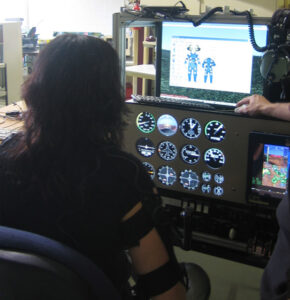 Of all the gizmos I’ve tried in my recent research, the tactile suit was the most exciting. Pilots can become disoriented because of poor or confusing visual feedback conflicting with other cues, a phenomenon that accounts for a significant proportion (up to 10%) of air accidents. The tactile suit is intended to help by letting the pilot feel their orientation through their body rather than trusting their vestibular (inner ear) or visual systems. Read More …
A hundred pixels is much better than none
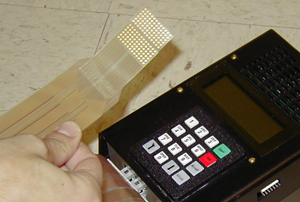 We’re so used to seeing megapixels these days that we don’t appreciate how even a few can make the difference between ‘seeing’ and being blind. I recently got the chance to try a tongue display—a device that literally displays images to the tongue using small currents—at the University of Wisconsin at Madison and at Wicab Inc.. If you experimented when you were a kid (!) it’s a little like putting a 9V battery on your tongue: or rather, 100 9V batteries. Read More …
Probably the best job in the world
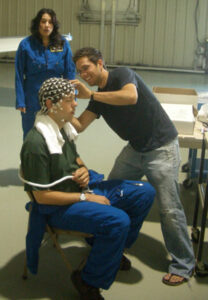 Tom Schnell (I just love nominative determinism) is a pilot and a flight instructor who runs a research lab where he gets to grapple with fundamental issues related to human perception and behavior. As Director of the Operator Performance Laboratory at the University of Iowa his job is to understand how pilots react while performing tasks in different sets of circumstances, which he does by hooking them up to many different sensors, including an electroencephalography (EEG) net to measure brain activity. (Will say more on this in a later blog.) Read More …