
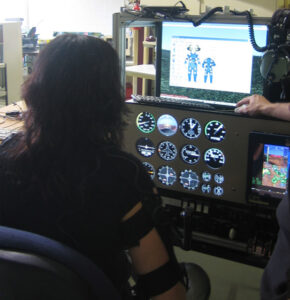
 Of all the gizmos I’ve tried in my recent research, the tactile suit was the most exciting. Pilots can become disoriented because of poor or confusing visual feedback conflicting with other cues, a phenomenon that accounts for a significant proportion (up to 10%) of air accidents. The tactile suit is intended to help by letting the pilot feel their orientation through their body rather than trusting their vestibular (inner ear) or visual systems. Read More …
Government backs medicine without science
 I don’t want this blog to become a tirade against pseudoscience: there are too many interesting, real science and technology stories out there to cover. Also, medicine is not usually my beat. However, in the UK, the support of pseudoscience—in the form of homeopathy—has recently become law. To me this speaks of a shift in this country away from science and towards superstition and wishful thinking: it’s therefore worth writing about. Read More …
A hundred pixels is much better than none
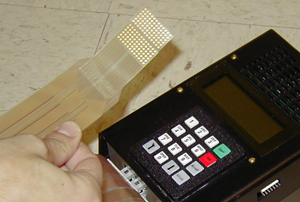 We’re so used to seeing megapixels these days that we don’t appreciate how even a few can make the difference between ‘seeing’ and being blind. I recently got the chance to try a tongue display—a device that literally displays images to the tongue using small currents—at the University of Wisconsin at Madison and at Wicab Inc.. If you experimented when you were a kid (!) it’s a little like putting a 9V battery on your tongue: or rather, 100 9V batteries. Read More …
First? No. Breakthrough? Maybe.
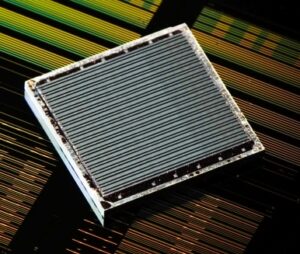 Last week’s announcement of the “World’s first hybrid silicon laser,” made me both excited and annoyed. I’ve been following the promise of optical interconnect technology for almost two decades, and have written a few reviews of the technology over the years. Researchers have come up with many interesting schemes for routing light around chips, boards, and computers: these include integrated silicon waveguides, planar waveguides, free-space interconnects, and photonic crystal pathways (I haven’t written about these but know people working on them). These all have tremendous potential in terms of improving on-chip, chip-chip, or board-board communication. Apart from the obvious, applications include one that I am passionate about: full interconnection of brainlike artificial neural networks. Read More …
Probably the best job in the world
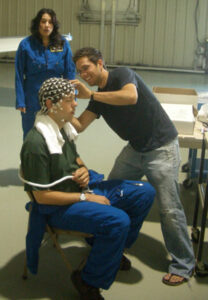 Tom Schnell (I just love nominative determinism) is a pilot and a flight instructor who runs a research lab where he gets to grapple with fundamental issues related to human perception and behavior. As Director of the Operator Performance Laboratory at the University of Iowa his job is to understand how pilots react while performing tasks in different sets of circumstances, which he does by hooking them up to many different sensors, including an electroencephalography (EEG) net to measure brain activity. (Will say more on this in a later blog.) Read More …
Wissenschaft (Or you can’t take the terror out of the girl…)
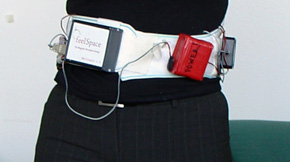 Last week I was visiting a laboratory in a medium-to-large town in the north of Germany, where I was given a belt to wear as part of an experiment. I don’t want to go into details of what the belt was for as it’s for a forthcoming magazine feature: I’ll say more in a later post once the article has been published. For now, let’s just say it was a kind of wearable computer, and the experiment involved walking around town wearing the thing. Which I did. Read More …