
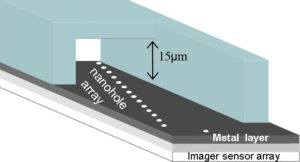
 New ‘lab-on-a-chip’ systems, usually a few centimetres on a side or less, are currently in use or development for all kinds of chemical and biological applications: from testing water for pathogens to genetic sequencing. A liquid sample injected (or pulled) into the chip travels through micro-channels etched into glass, plastic, or silicon. These lead the sample through the chip to testing sites, with progress controlled by tiny, integrated, electronic or mechanical devices. Read More …
Roses in January
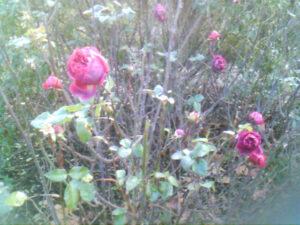 Global warming seems to have been following me around lately.
It was pretty warm before I left London in mid-December. Then New York was a bizarre 60°F (16°C) almost every day I was there, the feeling was quite incongruous with all of the winter holiday lights blazing. Leaves were still on many trees and the idea of a white Christmas seemed laughable. Read More …
Fuzzy thinking
 I love watching CSI: Crime Scene Investigation, but there’s one thing that makes me want to throw things at the television. Here’s how it goes. The investigators have found a security camera at the scene and have taken the tape back to the lab. They roll forward to the point where the crime is taking place, and look for clues about the perpetrator: maybe a badge, a signet ring, or tattoo. “Zoom in on the ring,” says the person in charge, and the grainy, highly-pixelated image of the ring fills the screen. “Now enhance that section.” Magically, the 50 or so pixels that show the ring vanish and a clear, crisp image of the ring appears in its place. Read More …
My philosophy about philosophy
 I’ve recently been working on a major article, for which I’ve interviewed something like 30 different people. Obviously you do some investigation before you set up a meeting, so you have a reasonable expectation that it’s going to be interesting. And indeed, most for this story were. All but one: with a philosopher. I actually walked out of the room early using the words, “I mustn’t take up any more of your time.” Read More …
Men with guns and bombs
 At the night vision conference I attended recently, I found myself in a new culture. I’ve written about technology that could be used for military applications for years, but almost always through academic and industrial institutions: so I’ve never been forced to really face up to what the technology was for. It’s one thing to know intellectually that the system you’re writing about is for night vision for soldiers. It’s another thing to see people testing them out by looking down the barrel of a gun. Read More …
The Templeton Foundation III: Cash for rose-tinted spectacles
 Shortly after I wrote the pieces for the Times Higher Educational Supplement and Association of British Science Writers newsletter last year, Prof. Paul Davies (a well-known physicist and former Templeton prizewinner) contacted me and asked if I would be willing to participate in a documentary about the Templeton Foundation being put together by an Australian team. I was, he said, one of the few people willing to take the anti-Templeton side. I took his request at face value and, initially, I agreed. Read More …
The Templeton Foundation II: The Agenda
 The Foundation was set up by Sir John Templeton (now in his mid-90s), who made his money in the financial markets. Though supposedly set up “to pursue new insights at the boundary between theology and science”, it funds many activities that are entirely religious. These include the Epiphany prizefor the, “most inspiring movie and the most inspiring television program of the year… presented by the Christian Film & Television Commission.” There is a similar film prize for Europe, plus three prizes for religious journalism. Though not traditionally creationist, the Templeton Foundation Press publishes many books that suggest that the universe was ‘designed’. Read More …
The Templeton Foundation I: Buying science
 One of the most insidious programs I’ve ever been invited to apply for (needless to say, I declined) is the Templeton-Cambridge Journalism Fellowships in Science and Religion. Run in part by the faculty of Divinity at Cambridge University, it’s stated aim is offer, “an opportunity to examine the dynamic and creative interface between science and religion.” Or, in my words, to help blur the edges between science and religion. Since a postcard from them just dropped through my door (again) I thought now might be the right time to discuss this program and the foundation that funds it. Read More …
A little night vision
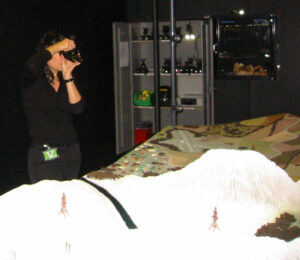 Over the last couple of weeks I’ve had the chance to try two pairs of night vision goggles (NVGs). The first I tried while on a visit to the Royal Air Force base at Henlow (see right). I was allowed to sit in with part of a training course for eight pilots (six Harrier jump jet, two Tornado, if you’re interested) who were about to fly with night vision for the first time. Read More …
Driving by wire
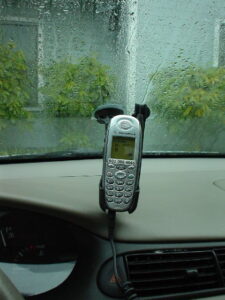 I’m a pretty good navigator, but it’s still a pain (and sometimes dangerous) to drive around places you don’t know and read maps at the same time. So, when I was in going to the mid-West and California on business in September I decided to try satnav. Though this technology has been around for decades, it had never seemed to me worth paying for. For this trip, however, my schedule was so tight and my exhaustion level was clearly going to be so high that I thought it might be a one way of taking the pressure off. It really was. Read More …