 After some time off to focus on teaching at UCL, in the last couple of years I’ve been starting to write about neuromorphic engineering (and other topics related to intelligent machines) again. This started at the beginning of 2018 when I wrote a case study on photonics in neuromorphic systems for my book on reporting on emerging technologies. Last year I wrote a feature for Nature Electronics‘ delayed special issue on neuromorphic computing (now scheduled to come out this summer) and this year I’ve started writing for EETimes again. I commissioned a special project on the subject for them and have also started writing a regular column on Brains and Machines.
My passion for this subject is greater than ever, and I am working on a book on this subject. More as the work develops.
 I don’t know much about this widely-publicized project to build a electronic brain in a brain-sized package as I’ve just found out about it and I haven’t yet managed to get my hands on any real technical information. However, reading the
  I’ve been interested in on-chip and chip-to-chip communications for many years, partly because optics looked likely to be an important technology in this area, and partly because dense interconnectivity is important for neural systems. However, you may be interested in an advance in interconnects for a different purpose: allowing electronics to stretch and conform. The UIUC team that did the work have used it to build a hemispherical detector, and the technology may well have an important impact on wearable sensors and actuators.
 I was on the phone today with Mary Lou Jepsen, founding Chief Technology Officer of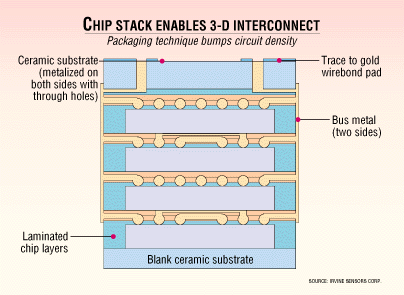
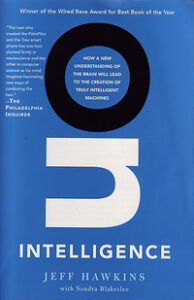 I have mixed feelings about what I consider to be ‘celebrity’ popular science books: being big in Silicon Valley and having something sensible to say about intelligent machines are two different things. In my view, however, Jeff Hawkins has paid his dues and deserves to be taken seriously. Though there is a lot wrong with On Intelligence, I believe Hawkins central theses—that much of what we call intelligence is based on the ability of our neocortex to make predictions, that the function of the neocortex is basic across sensing and actuation, and that this function can be understood in a relatively straightforward way—are all correct. If we’re smart, some of us in the machine intelligence and neuroscience communities will take up his challenge to work on filling out this new theory.
  Saw an interesting talk yesterday. The