
Although I’ve no doubt that digital computing will be crucial to the development of intelligent robotics, one of my interests is in the other—often neglected—technologies that will also be vital to making it happen. One of these is mechanics. The video shown here (top) is Domo, one of the latest robots being developed at the MIT Computer Science and Artificial Intelligence Laboratory. As well as incorporating many new ideas, this robot builds on one concept that was developed at the AI lab a decade ago: the idea of compliant limbs.
Author: Sunny Bains
On Intelligence by Jeff Hawkins
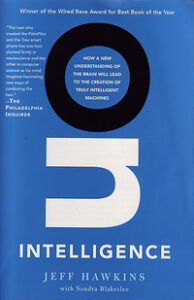 I have mixed feelings about what I consider to be ‘celebrity’ popular science books: being big in Silicon Valley and having something sensible to say about intelligent machines are two different things. In my view, however, Jeff Hawkins has paid his dues and deserves to be taken seriously. Though there is a lot wrong with On Intelligence, I believe Hawkins central theses—that much of what we call intelligence is based on the ability of our neocortex to make predictions, that the function of the neocortex is basic across sensing and actuation, and that this function can be understood in a relatively straightforward way—are all correct. If we’re smart, some of us in the machine intelligence and neuroscience communities will take up his challenge to work on filling out this new theory. Read More …
An Oxford Charade?
 Saw an interesting talk yesterday. The Visual Geometry Group from Oxford University claimed to have developed a technique for automatically tagging video content (both arbitrary objects and faces) so that it was easily searchable in real time. The faces could even be labelled as particular actors or characters using online resources. The goal was to have a video version of Google where you can search by names, faces, logos, object images, anything. Although searching is not an area I particularly follow, the work seemed to have important implications for machine vision and I was amazed at how effective it was as described in the presentation. Read More …
Making the best of what you’ve got
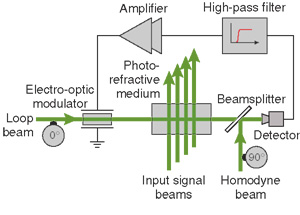
This holographic systems pulls out individual sounds from noise using feedback. Click the image to hear this happen.
When I discuss analog computation with most people, their instant reaction is to explain to me that there is no such thing as analog. For instance, one of the comments on an earlier post I wrote on analog vision pointed out that using a film-based camera rather than a digital camera doesn’t give you infinite resolution, just a higher, finite resolution. In this case the the limit is grains of silver on the film rather than the number of pixels on a camera array. This is true, but it also misses the point. Read More …
Seeing Voices by Oliver Sacks
 Seeing Voices, first published 1989, is an odd book. Partly it deals the history of the education, culture, politics, experience, and isolation of the deaf (not normally things that I would cover here). Partly it deals with the science of how sensory inputs and language are processed in the brain (at least, as it was understood at the time). Partly it is a mess of footnotes, many of which are more interesting than the main text (do yourself a favor and make sure you get an edition that has the footnotes on each page and not at the back!). This lack of integration makes the book a frustrating read at times, but I still found it worthwhile. Read More …
Senses: What are they good for?
 When I first heard the story about the Feelspace or North belt, one of the things that excited me the most was that it demonstrated how we learn from all the stimuli we are regularly in contact with, even those that don’t seem very special. We learn that does and doesn’t ‘feel right’ from the swish of our winter coats to the sound of our shoes on the ground to the vibration of our cars. We don’t just do passives ensing, but active: we interact with the world in routine ways and can tell something about our environment by the way it reacts to us. Read More …
Loser: IEEE Spectrum on tongue display
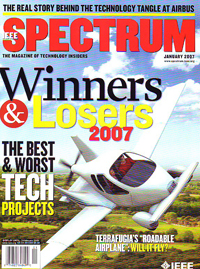 One of my colleagues told me at lunch that he’d seen an IEEE Spectrum article saying that the Wicab tongue display was one of the ‘loser’ technologies of 2007, so I thought I’d take a quick break from the idea of intuitive displays to deal with this. I was very disappointed with the article, in that none of the ‘experts’ quoted seemed to have any specific knowledge of the device, how it was perceived by users, what it felt like to use etc. Also, it was not noted that these people were, essentially, competitors. (I have no axe to grind except that I think it was bad journalism). Read More …
Physical intuition
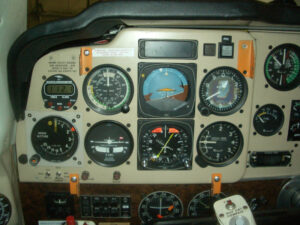 After the last couple of posts I got some interesting comments about familiarity being important to intuition. Roger Attrill pointed out that Adobe users would find Photoshop intuitive (while others wouldn’t) and Bob Salmon pointed out that musicians might find software using some kind of musical-score based interface natural to use that the rest of us wouldn’t. Read More …
Getting complicated
 During my recent research into the world of sensory interfaces, I had at least a dozen discussions, maybe more, about what the word intuitive means. I can’t remotely claim to have cracked this: on the contrary, it seems to me that people are still at the stage of figuring out the right questions to ask. It’s true that human-machine interfaces have been well studied and there’s vast literature on the subject. However, though sensory interfaces that allow you to interact with the real world (rather than a computer world) will certainly have many things in common with virtual displays, I think there will be some differences too. Read More …
Intuition versus attention
 One of the aspirations of those trying to feed information into the brain through the senses is how to make the process intuitive. Roughly we know what this means: we want to have the information be self-explanatory, to not require any further thought, to immediately and naturally provoke the behavior that we intended. But what exactly does this mean in practice? How does it break down? Read More …